
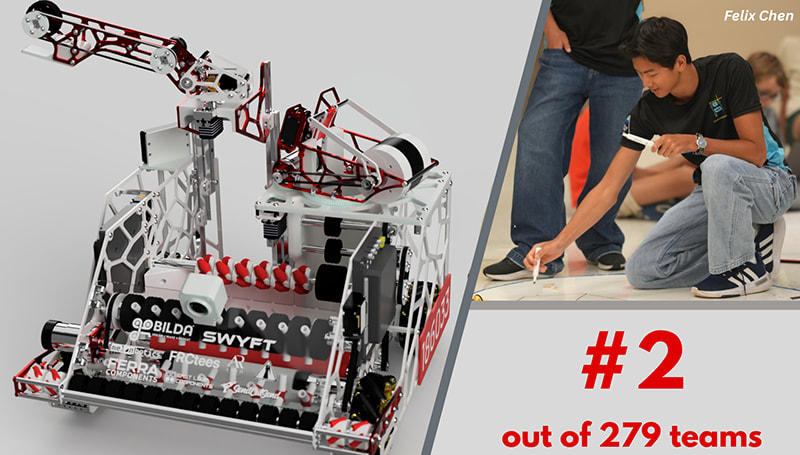
Recently our captain and lead CAD designer Felix Chen earned second place in the inaugural 2026 FIRST Tech Challenge (FTC) Discord Computer-Aided Design (CAD) Competition, held online July 18-25.
Felix was awarded nearly $1,000 in cash and gift cards from robotics-related companies for his second-place finish among 279 individual competitors and robotics teams from around the world, including Romania and Australia.
The week-long competition challenged high school students to design a robot for the fictional FTC game “Chain Reaction,” document their design process and strategy, and present their work to judges for evaluation. Participants competed individually or in teams of up to three students.
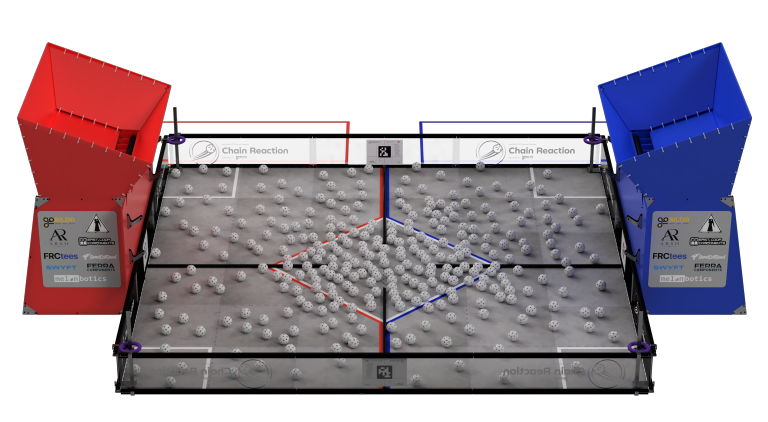
“CAD involves designing several custom-made mechanisms and parts on a computer, where it can be assembled into a robot completely virtually,” Felix explained. “The main objective was to design a robot specified by specific rules to pretend to compete in a fictional game, where robots were tasked with shooting hundreds of wiffle balls and controlling rings on the field.”
Competitors had exactly one week to design their robot using the CAD software of their choice before documenting their game strategy and the decisions behind their design. Felix used Onshape to design his robot and Fusion 360 to create high-quality renderings.
The challenge was particularly demanding because Felix competed as a solo designer while balancing other responsibilities during the week.
“The most challenging part was the fact that I had several responsibilities and conflicts during the week of the competition,” Felix said. “I only had about half the time as other competitors, and I didn’t have any teammates to split up the work with. Nevertheless, I managed to finish within time, which is always the most rewarding part of designing robots.”
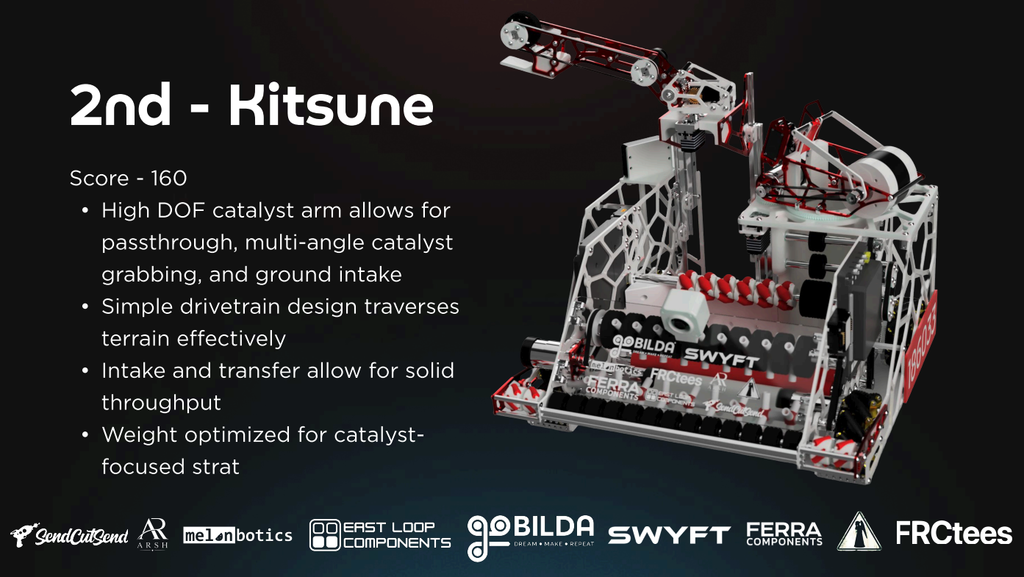
Judges evaluated each submission using a set rubric that considered factors including design, functionality, strategy and presentation. Felix’s design stood out for several reasons, including a unique arm designed to grab rings, careful weight optimization and a lack of CAD errors.
“Some aspects that stood out to judges was the unique arm I designed for grabbing rings, the weight optimization, and I was one of the few teams with zero CAD errors,” Felix said. “The robot also ranked highly in aesthetics, with a bold red and white design that I had never tried before.”
Finishing second among 279 competitors was a confidence-building accomplishment for Felix, who said the result affirmed the skills he has developed through his work in robotics.
“Finishing in second was a defining moment for me as it proves that even amongst some of the best designers in other highly successful robotics teams, my skills as a solo designer prevailed,” he said.